

A commercial lock does not require rekeying solely because it has remained in use for several years. The useful question is whether current keyholders are still authorized.
That matters for an office, retail store, warehouse, or shared commercial property in Lauderdale Lakes. A missing key, staff change, new tenant, or change in building responsibilities can create an access gap. Rekeying addresses that problem without automatically replacing sound lock hardware.
The Access List Has Changed. Has the Lock?
Review the locks whenever the access list changes. Consider who else has access: contractors, former tenants, vendors, and property managers may hold keys.
Ask:
- Who has a key today?
- Which doors does each key open?
- Are all issued keys accounted for?
- Can anyone still enter despite no longer needing access?
If the answers are unclear, commercial lock rekeying deserves consideration.
A Former Employee Does Not Always Mean Every Door Needs a New Key
Employee turnover is a common reason to review business lock security, but the response should match the access that person had. One worker may have had an office key, while a supervisor held the master key. Changing one cylinder does not necessarily remove wider access.
Check the current key setup before scheduling a service call.
A Missing Key Changes the Risk
A missing key does not always create an emergency, although some situations warrant a prompt response. Note where it went missing and whether it had identifying details.
Greater concern exists when:
- The key was lost near the business.
- It was attached to an identifying tag.
- A master key is missing.
- The key opens a restricted room.
- The business cannot determine whether copies exist.
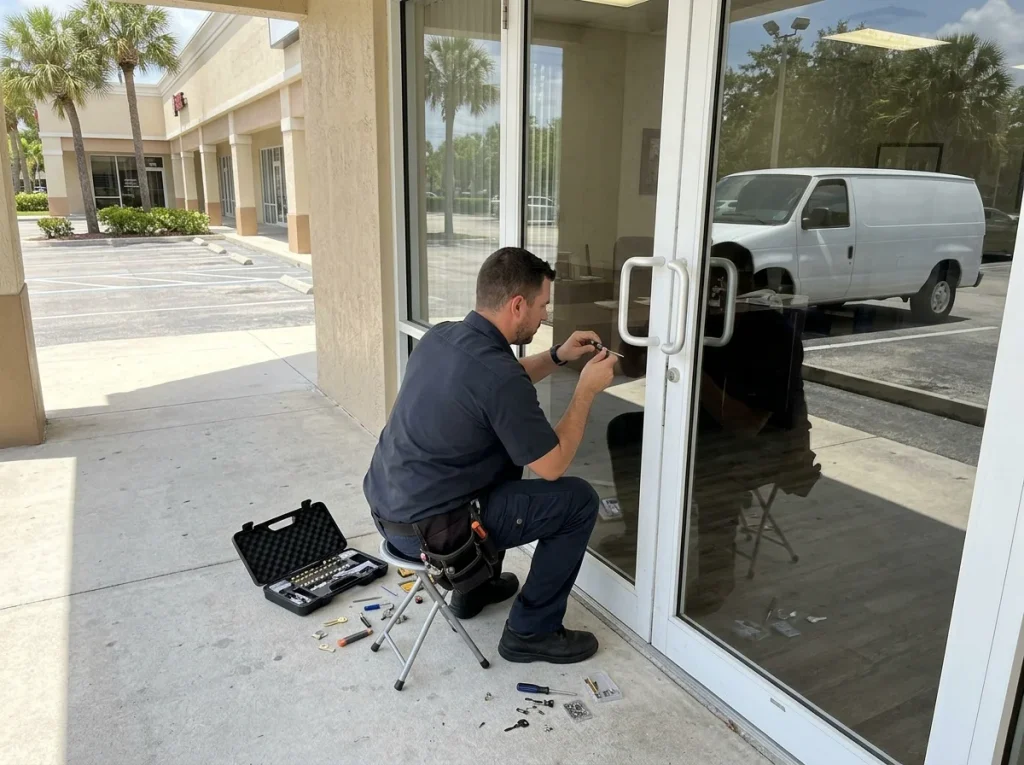
Rekeying a commercial door lock modifies the internal mechanism within a compatible lock cylinder. The old key then no longer operates that cylinder. This is useful when the physical lock is sound, but confidence in the existing keys has been lost.
New Ownership or a New Suite Calls for a Different Question
Moving into a Lauderdale Lakes commercial property creates another issue: you may not know how many previous key copies are still circulating. A landlord, former tenant, contractor, or former employee could have had access.
For a new tenant, commercial property lock rekeying is worth discussing before regular operations begin. The same applies after acquiring another company.
Not Every Security Upgrade Requires New Hardware
Rekeying and replacing locks solve different problems.
| Situation | More likely direction |
| Existing lock works and keys changed hands | Rekeying |
| A key has been lost | Rekeying may be appropriate |
| Cylinder is worn or damaged | Replacement |
| Restricted key control is needed | Hardware or system upgrade may help |
| Credential-based entry is planned | Electronic access review |
This can prevent unnecessary replacement when the real weakness is uncontrolled keys.
When a Master Key System Gets Complicated
Master key systems call for extra care since one change can affect multiple access levels. Different users may have different permissions even though their keys work within the same property.
Before rekeying, identify:
- Exterior entry points
- Private offices
- Storage and inventory rooms
- Utility areas
- Restricted records or equipment areas
- Doors operated by master keys
A qualified locksmith can identify which cylinders require rekeying, avoiding the need to replace every lock.
Lauderdale Lakes Businesses Still Have to Think About Egress
Security hardware cannot be selected only for its ability to keep people out. Commercial doors that form part of a means of egress have life-safety requirements when a business changes its locking arrangement.
Florida’s current 8th Edition (2023) Florida Building Code took effect on December 31, 2023, and the state has continued issuing supplements while the 2026 code update is being developed. The code addresses doors, means of egress, and life-safety requirements, so businesses should have proposed locking changes reviewed appropriately.
Lauderdale Lakes has an estimated population of 36,898 as of July 1, 2025, giving local commercial properties a local community to serve.
Build Rekeying Into the Key Lifecycle
Businesses can make access reviews part of normal operations:
Onboarding: Issue only needed keys.
Role changes: Recover old keys before adding access.
Departure: Collect keys and verify restricted access has ended.
Lost key: Record what disappeared and identify exposed cylinders.
Relocation: Establish a known key set instead of inheriting an unknown one.
This makes rekeying part of routine security management.
Three Signs You Should Not Delay
Move rekeying higher on the priority list when:
- You cannot account for a key that opens an important door.
- A past employee has kept a key that still grants entry to the business.
- You are unsure who previously had access to a newly occupied property.
If the lock is sticking, damaged, or outdated, ask whether rekeying is enough. A commercial locksmith can evaluate the cylinder, hardware, and master key arrangement together. Key Decipher, LLC. can help businesses review these factors and determine whether rekeying existing locks, changing cylinders, or considering another access solution makes sense.
Frequently Asked Questions
When should commercial locks be rekeyed?
A business should rekey its locks whenever authorized key access changes or can no longer be verified. Examples include employee departures, missing keys, property relocation, changes in tenancy, and changes to who needs access to restricted areas.
Can I rekey commercial locks without replacing them?
Usually, yes, when the existing lock cylinder is compatible and in suitable condition. Rekeying changes the cylinder’s internal key configuration rather than replacing the entire lock. Replacement may be the better option when a lock is damaged or severely worn.
Is rekeying necessary when an employee leaves the company?
That depends on whether every key was returned and which doors those keys unlocked. Rekeying may be advisable if a key is unaccounted for or the employee could enter sensitive or restricted areas. If a master key was involved, the wider access system should be reviewed.
Is rekeying useful after moving into a commercial building?
Yes. Incoming tenants cannot be certain how many duplicate keys remain in use. Rekeying can establish a known starting point for the new business’s key control instead of relying on an inherited key history.
Final Thoughts: Keep Commercial Access in the Right Hands
There is no one-size-fits-all rekeying interval for every Lauderdale Lakes business. The stronger approach is to review access whenever people, tenants, keys, or building responsibilities change.
Key Decipher, LLC. can help evaluate whether the existing lock cylinder, master key system, or broader access setup still matches the business’s current needs.