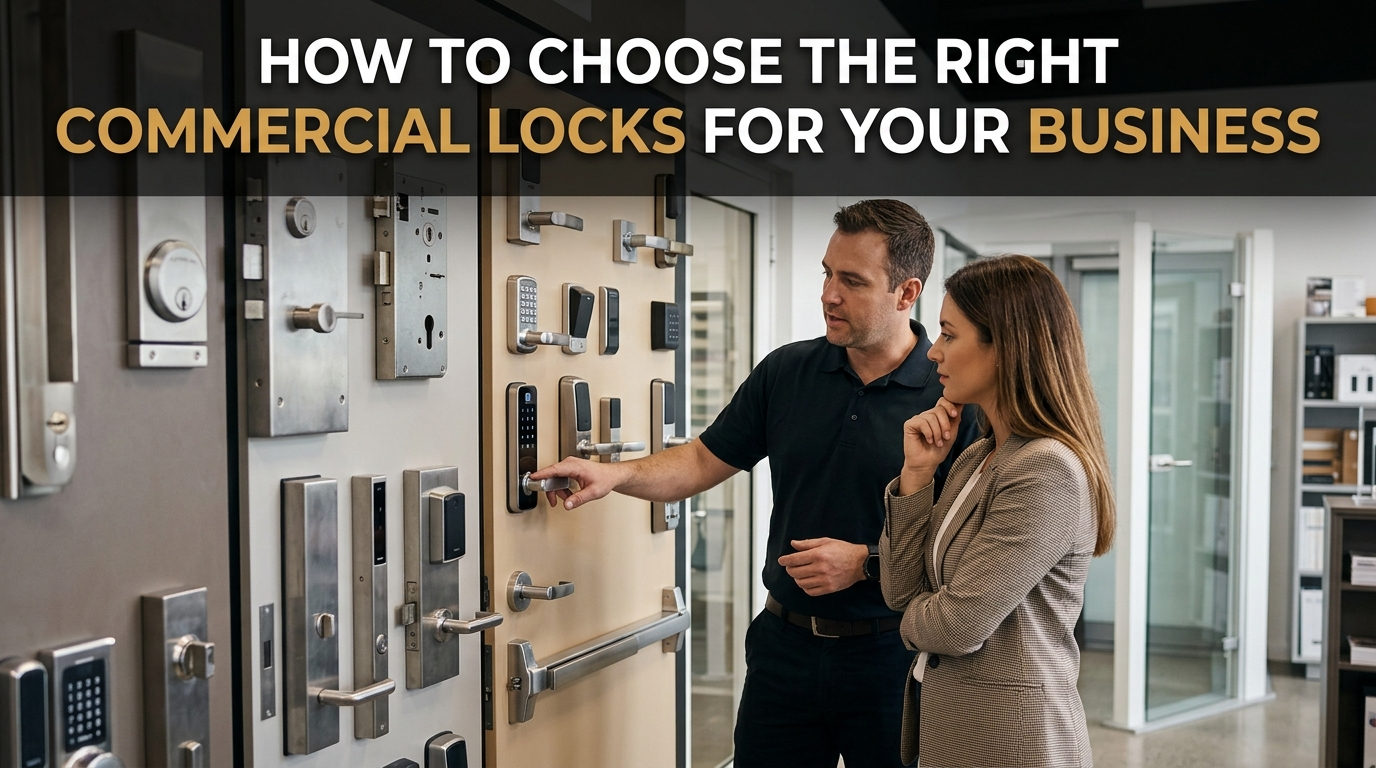
A lock that works well on a small office door probably wouldn’t be the best option for a hectic storefront or a warehouse with expensive equipment. The difference comes down to how the door is used, who needs access, and what happens if someone enters without permission. Buying commercial locks is not a matter of picking the strongest lock for the door. It’s matching locks to a particular security job.
For Lauderdale Lakes and surrounding South Florida businesses, the choice can impact business operations just as much as the protection of property. Lauderdale Lakes had an estimated 36,898 residents in July 2025, according to the U.S. Census Bureau. A realistic security solution for local business owners should take into consideration the staff, customers, deliveries, and various areas of the commercial property.
Start With a Door-by-Door Security Plan
Take a stroll through the property and inspect all the entrances before you look at brands and prices. One building can have a public entrance, an employee entrance, a supply closet, and a back entrance. Having all the doors locked in the same way can lead to leaving sensitive areas unlocked or make routine tasks more challenging.
Use this quick assessment to identify what each door needs:
- Front entrance: Handles frequent traffic and needs reliable locking hardware that suits the door and its use.
- Employee entrance: May need controlled access outside normal business hours.
- Office or records room: May require restricted keys or individual access permissions.
- Stockroom or warehouse: Needs hardware suited to the value of stored goods and the frequency of use.
- Emergency exit: Must allow safe, code-compliant evacuation.
This basic inventory defines a starting point for the commercial lock selection.
Match the Lock Mechanism to the Door
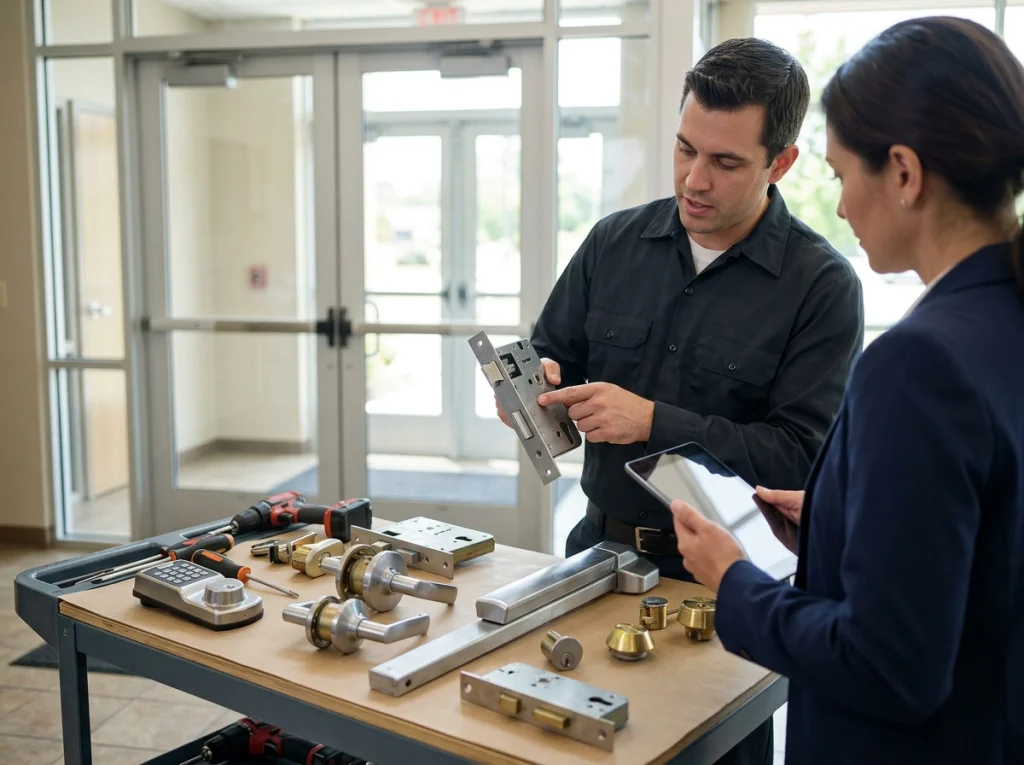
Not all commercial lock mechanisms are suitable for every door. Compatibility depends on the type of latch, the condition of the door frame, the door material and thickness, and any existing cutouts. These factors should also be considered if the business later needs commercial lock rekeying after a security change or staff turnover. Overlooking them could result in hardware that requires extra adjustments, making the installation unreliable and more expensive.
| Lock type | Where it may fit | Main consideration |
| Cylindrical lock | Office doors and many standard commercial doors | Practical for everyday use |
| Mortise lock | Compatible commercial doors, including some busy entrances | Requires a suitable mortise preparation |
| Deadbolt | Compatible doors needing an additional locking point | Must work with the door and exit requirements |
| Electronic lock | Employee entrances and restricted rooms | Needs suitable credentials, power, and backup arrangements |
| Panic bar | Certain commercial exit doors | Must meet applicable egress and fire safety requirements |
The strength of the door and frame also plays a role in a lock’s effectiveness. A good mechanism that was added to a damaged or poorly aligned piece of machinery could still be less than satisfactory. If a door sticks, does not latch, or is showing signs of forced entry, have the full assembly assess it.
Understand Lock Grades Before Paying More
Commercial lock grades help compare durability and performance. Under the ANSI/BHMA grading system, Grade 1 is the highest of the three common grades, followed by Grade 2 and Grade 3.
The right grade depends on use, not simply the size of the business.
- Grade 1: Consider for demanding applications and doors that experience heavy use.
- Grade 2: Often suitable for many standard commercial applications with moderate demands.
- Grade 3: May suit lighter-duty applications when the product is approved for the intended use.
Check the manufacturer’s specifications rather than assuming every product in a grade performs identically. Be sure to take into account the lock cylinder, latch, strike plate, fasteners, and frame. A durable lock cannot compensate for weak surrounding hardware.
Choose Mechanical or Electronic Access
The decision between traditional keys and electronic access should reflect how the business manages people, not just which technology looks newer.
Mechanical locks are often straightforward to operate and do not depend on electronic power. However, lost keys, copied keys, and unreturned keys can create control problems. Rekeying may be necessary when access can no longer be trusted.
Electronic locks can use PIN codes, cards, fobs, or mobile credentials, depending on the system. They may allow managers to remove access without replacing the entire lock and can support different permissions for different employees. They also introduce considerations such as battery changes, system costs, software management, and backup entry.
If the number of authorized users is low, it might be possible to get away with a mechanical system in a small office. If the property has a large number of staff and a high turnover of staff or limited room, it could be advantageous to use an access control system. Both are not inherently more secure; their security depends largely on their installation and maintenance.
Control Who Holds Keys and Credentials
Even a strong lock has limits if former employees still have access or too many people can enter restricted rooms. The key control plan must be in place from the start.
A workable policy should cover four things:
- Issue access deliberately. Give each employee access only to the areas required for their job.
- Track keys and credentials. Maintain a record of who receives them and which doors they open.
- Remove access promptly. Collect keys and deactivate electronic credentials when employment or duties change.
- Review lost keys. Decide whether rekeying or replacing hardware is needed based on the affected areas and the risk.
A master key for multiple rooms can eliminate the need for multiple keys, but must be carefully planned. A master key that opens too many sensitive areas can lead to a single point of risk. Security may also be enhanced by restricting keys or installing an electronic access system, depending on the business.
Do Not Overlook Florida Exit Requirements
In an emergency situation, people should be able to get out safely without any security hindering them. Locks, latches, and panic hardware may be restricted in certain doors by Florida building and fire safety codes.
For example, the applicable code may require panic or fire exit hardware for certain occupancies and occupant loads. This requirement varies depending on the type of building, where the doors are situated, and the prevailing rules. There shall be no locking device on an exit door that restrains an authorized means of egress.
Check with the appropriate local building or fire official before switching hardware to ensure requirements are met for the property. A commercial locksmith can help identify compatible options, but some projects may also require review by a qualified design or inspection professional.
Compare the Full Cost, Not Just the Lock Price
Going with the cheapest lock at first might seem like a good move, but it often ends up costing more in the long run. When you are comparing your options, consider more factors, including installation charges, rekeying, replacement parts, maintenance, and any charges for electronic systems.
Ask these questions before approving a purchase:
- Is the lock compatible with the existing door and frame?
- Can authorized employees operate it easily?
- What happens if a key, card, or code is compromised?
- Will the hardware stand up to the expected daily use?
- Are replacement parts and support readily available?
Key Decipher, LLC. can help business owners evaluate commercial locking options according to their doors, access needs, and security priorities. The goal is to select suitable hardware for each opening rather than spend the same amount on every door.
Frequently Asked Questions
Which Commercial Locks Are Right for a Small Business?
The best lock depends on the door, what you’re protecting, and who needs access. A small office might do fine with sturdy mechanical locks. But if you have secured areas or regular staff changes, electronic access often makes more sense.
How often should commercial locks be replaced?
There’s no one-size-fits-all answer. Check hardware regularly and swap out or fix anything that’s been damaged, is unreliable, outdated, or simply doesn’t fit your property’s current security needs.
Should every employee have a key to the building?
Not necessarily. Employees should only get access to the areas they really need for their jobs. Limiting access keeps things more secure and makes it easier to manage if someone loses their key.
Can a commercial lock be installed on any door?
No. Door construction, thickness, frame condition, and current hardware all matter. Don’t forget to check fire ratings, accessibility, and emergency exit rules too; those can all affect what types of locks you can use.
Final Thoughts: Make Each Lock Serve a Purpose
The most effective commercial locking system begins with understanding the building, not shopping for the most expensive hardware. Match the lock to the door, consider traffic and durability, control employee access, and confirm that safety requirements are met.
For businesses in Lauderdale Lakes and nearby South Florida communities, Key Decipher, LLC. can help assess commercial locking needs and identify suitable hardware for different doors. A well-planned system protects business assets while keeping everyday access practical.