
An employee leaves, and the manager collects their uniform, closes their email account, and updates the schedule. Then someone asks for the office key, stockroom key, or master key, and nobody knows whether it was returned. Even when a key comes back, the business may not know whether copies were made.
For businesses in Lauderdale Lakes, Florida, employee departures are a good time to review who can physically enter the property. A clear key-return process helps protect staff, inventory, records, and restricted areas without automatically replacing every lock whenever someone leaves.
Start With a Complete Key Inventory
Before changing locks, establish which keys the departing employee was assigned and what each one opens. Check key logs, signed issue forms, manager records, and any master-key schedule. If records are incomplete, use the departure as a prompt to rebuild them.
A useful inventory record includes:
- The key identifier and doors or areas it opens.
- The employee who received it and the issue date.
- Whether it was returned, reported lost, or remains unaccounted for.
- Who verified the return and updated the record.
A Returned Key Does Not Always Mean Access Is Secure
Collecting a key does not prove that no duplicate exists. A former employee may have copied it, lent it to someone, or lost it without reporting the loss. The risk depends on the key’s permissions and the circumstances of the departure.
A supply-closet key is different from a master key that opens the entrance, offices, and storage rooms. If a high-access key is missing or unauthorized copying is suspected, assess the exposure promptly.
Decide When Rekeying Is Worth Considering
Rekeying changes a lock cylinder so old keys no longer operate it, while compatible hardware can often remain in place. Replacing a lock means installing new hardware, which may be needed if the lock is damaged, unsuitable, or cannot be rekeyed.
Consider rekeying when:
- A key for sensitive areas is missing or not returned.
- The business cannot confirm whether copies exist.
- A departing employee held a master key.
- There is a credible concern about unauthorized entry.
- Key records are unreliable after repeated staff changes.
The decision should reflect risk, not habit. If the key is returned, access was limited, and there is no sign of copying, keeping the existing configuration may be reasonable. A missing master key calls for a more cautious review. Businesses considering rekeying commercial locks should first identify every door affected by the key.
Match the Response to the Key’s Access Level
Not every employee needs the same access. A retail associate may need a sales-floor or back-room key, while a manager may need access to offices, inventory, and closing areas. A warehouse supervisor may also need loading-area access.
Reviewing commercial lock types and the overall key system can help. A restricted key system may limit unauthorized duplication, while a master-key system can provide different access levels. Master keys increase the consequences of a loss, so control assignments carefully.
For electronic access, remove the former employee’s credentials, codes, cards, or mobile permissions too. Changing a physical lock will not disable a separate access code.
Build a Repeatable Offboarding Checklist
Assign one manager or authorized person to complete and record each step.
- Confirm assigned access by checking key records and credentials.
- Collect keys, fobs, cards, and other access items.
- Compare returned items with the inventory and record anything missing.
- Disable relevant digital credentials and codes.
- Assess whether rekeying, replacement, or further inspection is appropriate.
- Record the decision, responsible person, and completion date.
Use the same process for resignations, dismissals, temporary workers, and contractors, adapting it to their access. If there is an immediate security concern, restrict access promptly instead of waiting for routine paperwork.
Account for Shared Buildings and Master Keys
In a multi-tenant office or retail property, a tenant may control its suite while a landlord or property manager controls common entrances and service rooms. Before changing a lock, confirm who owns it, who can approve the work, and whether other tenants rely on the same key.
Rekeying one cylinder may affect other access arrangements in a master-key system. Coordinate changes with the property manager and an authorized commercial locksmith to avoid locking out other approved users.
Lauderdale Lakes reports more than 500 active business tax receipts, reflecting a local business community with varied premises and operating needs.
Make Key Control Part of Everyday Security
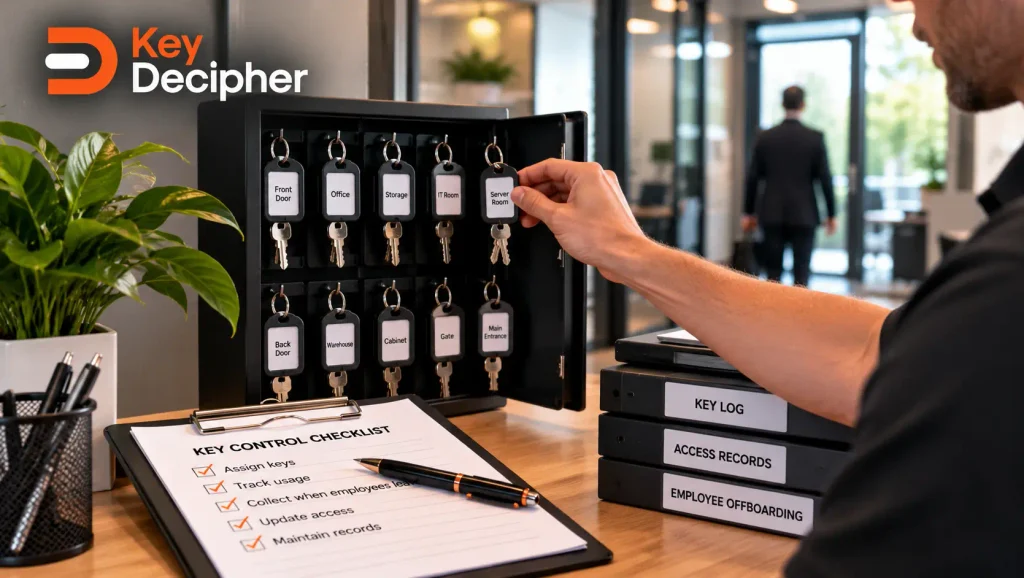
Record every key assignment, require approval for duplicate keys, and review who holds master keys whenever staffing or responsibilities change. Keep spare keys in a secure, controlled location and update your inventory immediately when keys are issued or returned. A consistent process helps prevent confusion and reduces the risk of unauthorized access.
Key Decipher, LLC. helps businesses address commercial lock and key-control concerns, including missing keys, employee departures, and changes in access requirements. Reviewing the existing lock system can help business owners determine whether updated key records, rekeying, or other security measures are appropriate for their property.
Frequently Asked Questions
Should a business rekey locks every time an employee leaves?
Not necessarily. Consider whether keys were returned, whether duplicates could exist, which areas they open, and whether the departure creates a credible security concern.
What if a former employee does not return a business key?
Record the missing key, identify the doors it operates, and assess the risk promptly. Rekeying may be appropriate when sensitive areas are exposed, or the key cannot be found.
Is rekeying cheaper than replacing commercial locks?
Rekeying often lets compatible hardware remain in place, while replacement involves new hardware. Costs depend on the lock type, number of cylinders, access system, and work required.
Who should manage the company key inventory?
Assign a manager, owner, or facilities lead. One accountable person should issue keys, record returns, secure the inventory, and arrange access changes.
What should businesses do about master keys?
Track each master key and limit assignments to authorized staff. If one goes missing, review every area it opens before deciding which cylinders or access arrangements need to change.
When should a business contact a commercial locksmith?
Contact one when keys are missing, access permissions are unclear, a master-key system needs changes, or the business is unsure whether rekeying or replacement is suitable.
Final Thoughts: Keep Control When Staff Move On
Employee turnover does not have to create a gap in physical security. A reliable inventory, documented key returns, timely removal of electronic access, and risk-based rekeying help businesses manage departures consistently.
For businesses in Lauderdale Lakes, Key Decipher, LLC. can help evaluate commercial key-control concerns and identify practical options for keeping authorized access organized as staffing changes.